
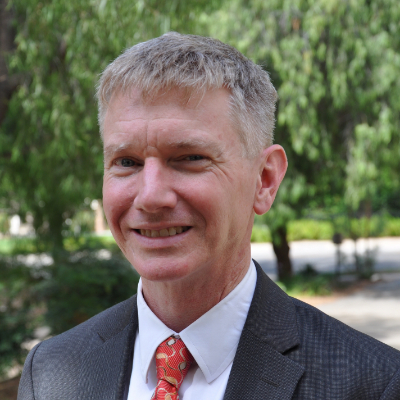
Kevin Michael Esterling
Professor of Political Science and Public Policy; Chair, Department of Political Science
RAISE @ UCR
CalCompute coalition · UC Riverside
Computational democracy UC; founding director, TeCD-Lab
Kevin Michael Esterling is a professor of political science and public policy at the University of California, Riverside, where he has served on the faculty since 2003 and currently chairs the Department of Political Science. He earned his Ph.D. in political science from the University of Chicago (1999) and his B.A. in government and foreign affairs from the University of Virginia (1989). He is the founding director of UCR’s Laboratory for Technology, Communication and Democracy (TeCD-Lab) and a longtime faculty director of the university’s Graduate Quantitative Methods Training Center (GradQuant). His work sits at the crossroads of democratic governance, information technology, computational social science and research transparency — areas directly relevant to California’s effort to build publicly accountable, equitable and democratically grounded AI infrastructure.
A central theme animating Esterling’s career is the belief that the benefits of advanced technology should be broadly accessible rather than concentrated in the hands of a few powerful actors. His book Politics With the People: Building a Directly Representative Democracy (Cambridge University Press, 2018, co-authored with Michael A. Neblo and David M.J. Lazer), cited by the American Academy of Arts and Sciences Commission on the Practice of Democratic Citizenship as a best-practice model, argues that scalable digital platforms can bring ordinary citizens into genuine dialogue with their elected representatives. This vision undergirds his ongoing development of Prytaneum, an open-source online town hall platform built by the TeCD-Lab and funded by the Institute of Education Sciences and the Democracy Fund, explicitly designed to advance constructive civic communication rather than the outrage and misinformation patterns of commercially incentivized platforms.
Esterling’s research speaks directly to the policy stakes of AI-generated and AI-amplified misinformation. In a landmark 2024 study published in Nature, Esterling and colleagues (McCabe, Ferrari, Green and Lazer) demonstrated empirically that Twitter’s post-January 6th deplatforming of accounts that “supershared” misinformation measurably reduced the overall reach of false content across the platform — providing rigorous, causal evidence that platform-level governance decisions have real downstream consequences for public information environments. The TeCD-Lab has also developed computational tools for analyzing public discourse at scale, including WIBA (What Is Being Argued?, IEEE ASONAM 2024), a machine learning framework for argument mining in legislative and online debate, and DALiSM, a discourse analysis framework for legislative and social media texts. His 2024 Political Analysis article introduces a flexible Bayesian model for estimating policy preferences of congressional witnesses from unstructured testimony.
In democratic governance research, Esterling is a leading figure in the use of randomized field experiments to study public deliberation. Collaborations with Harvard’s Archon Fung and Berkeley’s Taeku Lee produced influential experiments showing that well-designed deliberative processes produce persuasion and convergence rather than polarization — published in the British Journal of Political Science (2021) and supported by a $300,000 MacArthur Foundation grant. A 2024 study in the American Journal of Political Science assessed the benefits of public deliberation at scale, finding positive effects on participants’ political knowledge and satisfaction with democracy. His Connecting Classrooms to Congress project, funded by a $2 million Institute of Education Sciences grant, uses Prytaneum to bring K-12 students into structured online deliberations with members of Congress.
A third pillar of Esterling’s work addresses the accountability and transparency goals embedded in SB 53. Since the early 2010s, he has been a co-founder and government committee member of the Berkeley Initiative on Transparency in the Social Sciences (BITSS), and was a co-author of the influential 2014 Science article “Promoting Transparency in Social Science Research,” which helped catalyze a major reform movement in empirical research practices. His NSF-funded iREDS project (Institutional Re-engineering Ethical Discourse in STEM), conducted with Dena Plemmons and Brian Nosek, tested a lab-embedded intervention designed to improve research ethics in STEM laboratories; results published in PNAS (2020) demonstrated that structured discourse interventions can shift the ethical culture of research teams — a finding with direct implications for how AI development organizations might be structured to better internalize safety norms. He is a listed author on two forthcoming Nature papers on the reproducibility and replicability of social and behavioral sciences.
Affiliations: University of California, Riverside — Department of Political Science (Chair); School of Public Policy; Laboratory for Technology, Communication and Democracy (TeCD-Lab); Graduate Quantitative Methods Training Center (GradQuant); UC Institute on Global Conflict and Cooperation.