
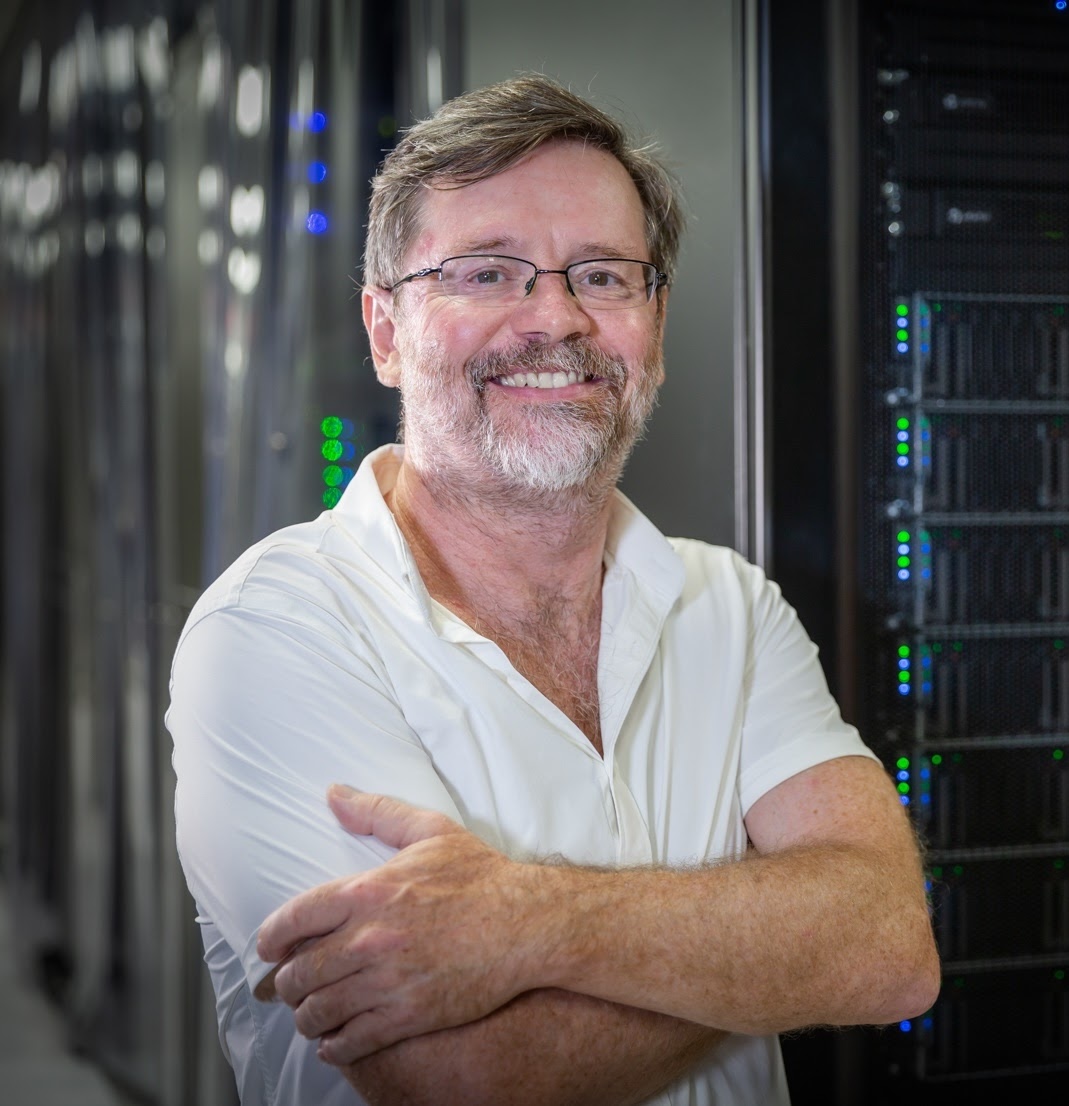
Frank Würthwein
Director, San Diego Supercomputer Center
University of California, San Diego
Runs the San Diego Supercomputer Center and the two shared computing systems that come closest to showing what public AI infrastructure looks like in practice
Frank Würthwein is director of the San Diego Supercomputer Center at UC San Diego, where he also holds faculty appointments in the Department of Physics and the Halıcıoğlu Data Science Institute. He has spent two decades building computing systems that many institutions share and none of them owns alone. That is the design problem SB-53 hands the CalCompute consortium, and he has already solved a version of it twice.
He became interim director of the supercomputer center in July 2021 and took the job permanently on Dec. 1, 2021, succeeding Michael Norman. The center employs more than 260 people and runs on an annual budget above $50 million, supporting research at UC San Diego and across a set of national collaborations. Würthwein joined the UC San Diego faculty in 2003, was a founding faculty member of the Halıcıoğlu Data Science Institute and led the center’s distributed high-throughput computing group before moving into the directorship.
His research is in globally distributed compute and data systems, and he is executive director of the Open Science Grid, the national infrastructure through which universities share computing capacity, software and data with each other. He is also principal investigator of the National Research Platform, a National Science Foundation funded system that pools more than 400 computational nodes across some 70 locations on three continents and serves over 5,000 active users. It offers graphics processors, petabyte-scale storage and hosted open-weight AI models, and it is governed by the institutions that contribute to it rather than by a vendor. Access is free to nonprofit research and education in the United States.
Closer to home, he and his team at the supercomputer center built the CENIC AI Resource with the Corporation for Education Network Initiatives in California, the nonprofit that runs the state’s research and education network. Campuses own their own equipment; the supercomputer center and CENIC handle operations, security and user support. As of March 2026 the resource spanned hardware at more than 20 California campuses across the UC and California State University systems and community college partners, totaling 1,044 graphics processors, 14,604 processor cores and more than 10 petabytes of storage. Würthwein has been blunt about why the model matters: “Of more than 400 accredited, degree-granting institutions in California, only 14 are classified as research-intensive (R1) universities, the kind that might plausibly afford a dedicated team of system administrators, cybersecurity professionals and user-support staff to run their own AI infrastructure. That is less than 3.5 percent of California colleges while the other 96.5 percent, including 116 community colleges serving 2.2 million students, and 23 CSUs serving nearly half a million more, face a stark choice: pay for expensive commercial cloud resources, go without or find a different model.”
In March 2026 CENIC gave Würthwein and his UC San Diego colleagues its AI Resource award for innovative technical design and instructional support, citing the work that made large language models usable on the platform along with the documentation and tutorials built around them. The team honored alongside him included Tom DeFanti, John Graham, Dima Mishin, Mohammad Sada, Mahidhar Tatineni, Tom Hutton, Daniel Diaz and Adam Tilghman. He serves as science advisor to the CENIC board of directors.
His academic work is in experimental particle physics, on the Compact Muon Solenoid experiment at CERN’s Large Hadron Collider, where he has worked on instrumentation and data analysis in searches for dark matter, supersymmetry and electroweak symmetry breaking. That field had to invent shared, globally distributed computing decades ago because no single laboratory could afford to analyze the data alone, and the methods he brought from it are the ones his California work now runs on.
Würthwein earned his doctorate at Cornell University in 1995 and held prior appointments at MIT and at Caltech, where he was a Millikan Fellow.