
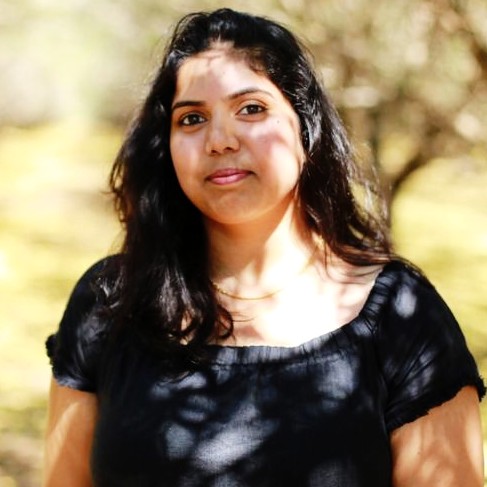
Sarvani Chadalapaka
Director of Cyberinfrastructure and Research Technologies
University of California, Merced
Leads a federally funded UC–CSU regional computing hub in the Central Valley — public research computing built for the campuses that were never going to buy their own
Sarvani Chadalapaka is director of cyberinfrastructure and research technologies at UC Merced, where she runs the campus’s high-performance computing and research technology operation and co-chairs its Committee on Research Computing. She has spent her career on a narrower version of the question SB-53 puts to the state: what it actually takes to get serious computing power into the hands of researchers and students at institutions that were never going to buy it themselves.
UC Merced is a useful place to have learned that. The campus has been a Hispanic-Serving Institution since 2010, more than 53 percent of its undergraduates are Hispanic and 71 percent are first-generation college students. When Chadalapaka arrived as an HPC administrator — she was in the role by 2017 — the campus cluster served roughly 40 researchers. It now serves more than 400. Her group does this with about four full-time staff and a couple of student consultants, running a JupyterHub that supports some 500 users and more than seven data science courses alongside the Pinnacles compute cluster.
Since 2024 she has been principal investigator of CENVAL-ARC, the Central Valley Accessible Research and Computational Hub, a $1 million National Science Foundation award running June 2024 through May 2027 under the Campus Cyberinfrastructure program. CENVAL-ARC is led by UC Merced in collaboration with three California State University campuses — CSU Sacramento, CSU Stanislaus and CSU Fresno — making it one of the few working precedents in California for computing infrastructure shared across the UC and CSU systems rather than built inside a single campus. Her co-investigators are Anna Klimaszewski-Patterson at Sacramento State and Suzanne Sindi and Emily Jane McTavish at UC Merced. New GPU and CPU capacity is federated into the existing Pinnacles cluster rather than stood up separately, and the award funds annual research symposia; the next runs March 5–6, 2026 at UC Merced. Asked what the grant was for, Chadalapaka put it plainly: “The overarching purpose is to provide computational research for researchers who don’t have access to cutting-edge technology.”
She writes about the method as well as practicing it. She is first author of “Cultivating Computational Equity: Building a Collaborative Research Computing Community in California’s Central Valley,” presented at PEARC ‘25 with collaborators from UC Santa Cruz, Sacramento State and Yale, and a co-author of “Kickstarting Research Support at Under-Resourced Institutions,” a PEARC ‘24 guide for campuses trying to assess what research computing capability they have and what they lack. In June 2025 she gave an invited talk on extending CENVAL-ARC’s resources to distributed high-throughput computing and widening user access.
Much of her service work has gone into the research computing workforce itself. She founded and directed the Women in HPC global mentoring program from 2019 to 2022, growing it to more than 60 volunteers across five continents and 25 countries; she was a 2017 Internet2 Inclusivity Initiative scholarship recipient and now co-chairs that initiative’s steering committee; and as diversity co-chair of PEARC 2020 she pushed through on-site childcare and dependent-care grants that later PEARC organizers kept. She has chaired the ACM undergraduate poster program at SuperComputing and the mentoring program at the first Women in HPC Summit, and serves on the UC Research IT Committee, the EDUCAUSE research computing and data steering committee and in the Campus Research Computing Consortium. In 2023 UC’s systemwide technology awards gave her a silver award for leadership in diversity, equity and inclusion, on a nomination from UC Merced’s chief information officer.
Chadalapaka holds a master’s degree in electrical engineering from the University of Texas at Arlington and a bachelor’s in electronics and communication engineering from India. She began in industry as an HPC systems engineer before moving to UC Merced.